


Our 14-Step GEO Action Plan
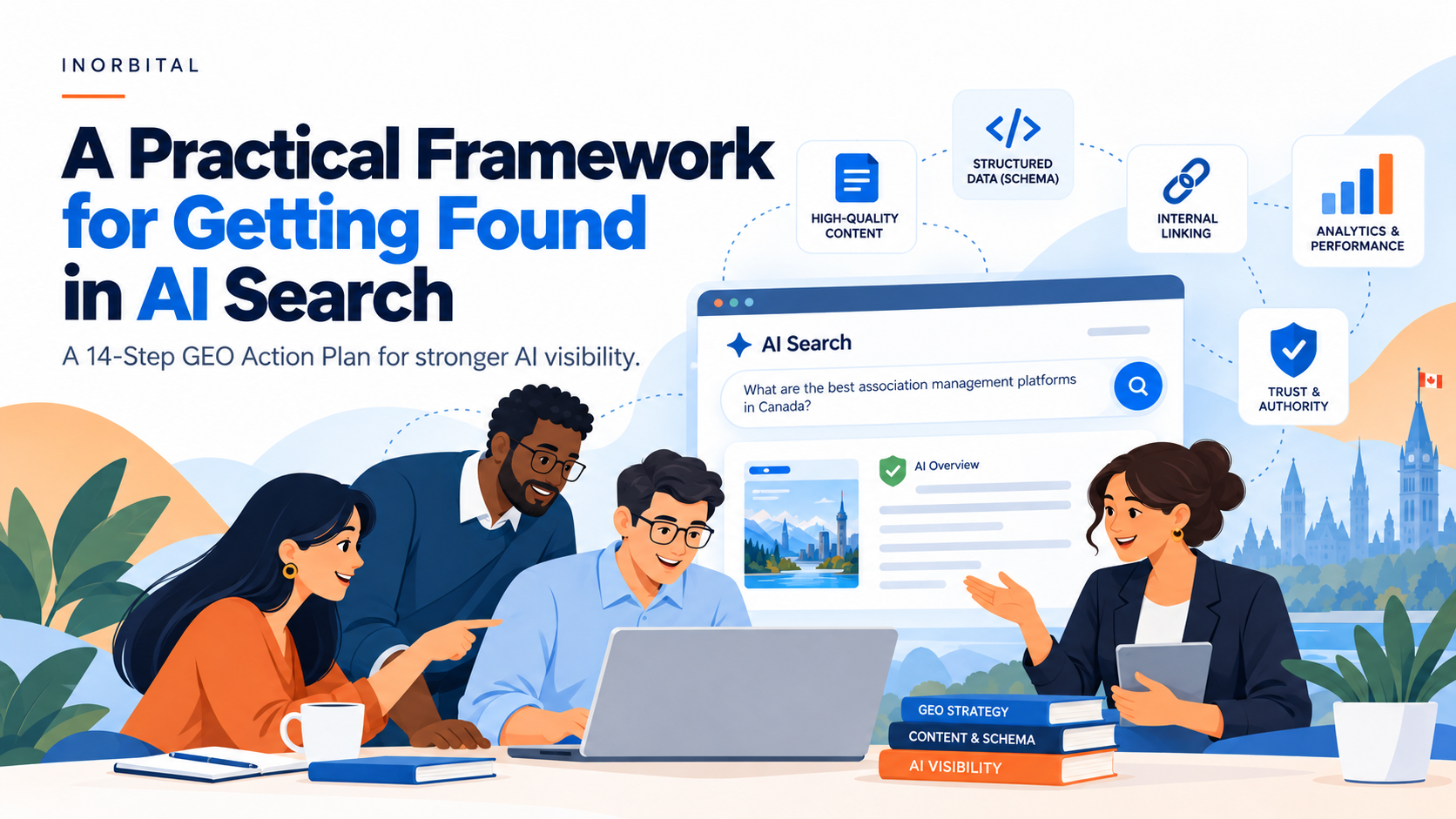
Search behavior is changing quickly.
More people are now using tools like ChatGPT, Gemini, Perplexity, and Copilot to research services, compare vendors, and get recommendations. That means showing up in traditional search results is no longer the full picture. Your website also needs to be understood, trusted, and surfaced by AI systems.
That is where GEO comes in.
GEO, or Generative Engine Optimization, is the process of improving how your organization appears in AI-generated responses. It builds on traditional SEO, but it goes further. SEO helps search engines rank your pages. GEO helps AI systems understand your business, connect it to the right topics, and reference it when users ask intent-driven questions.
At Inorbital, we developed a 14-Step GEO Action Plan to help organizations improve visibility in this new environment with a clear, practical framework.
This is not a gimmick. It is not about chasing AI hype. It is about making your website easier for AI systems to interpret, trust, and recommend.
Why GEO matters now
AI is already influencing how people discover brands and make decisions. When someone asks an AI tool a question like “Who are the best web design agencies for associations in Canada?” or “What CMS partner has strong accessibility experience?” the answer is often shaped by how clearly organizations present their expertise online.
If your website is vague, poorly structured, thin on authority signals, or inconsistent in how it describes your services, AI systems are less likely to surface you. If your website is well organized, technically sound, and rich in trust-building content, your chances improve.
That is the purpose of our GEO Action Plan.
What is included in our 14-Step GEO Action Plan?
Our framework takes a broad view of what drives AI visibility. It does not stop at content. It also addresses structure, technical alignment, trust, and authority.
1. Homepage GEO Positioning
We strengthen homepage messaging so both users and AI systems can quickly understand who you are, what you do, and who you serve.
2. Entity Clarity Optimization
We improve how your organization, services, expertise, and market focus are defined so your business identity is clearer to AI systems.
3. LLM Optimization
We help shape the content and structural signals that large language models use to interpret and summarize your website.
4. Content Structuring for GEO
We organize content in a way that makes it easier for AI tools to extract useful information, identify relevance, and connect related topics.
5. AI Content Optimization
We refine content so it is more likely to appear in AI-generated answers, summaries, and recommendations.
6. Schema Optimization
We review and improve structured data to support better understanding of your content, services, organization, and authority.
7. Development Work
We implement the technical updates needed to support GEO properly, not just document recommendations and leave them sitting in a deck.
8. Trust Signal Structuring
We improve the visibility of credibility signals such as expertise, experience, proof points, certifications, clients, and other indicators of trust.
9. Internal Linking Optimization
We strengthen the relationships between pages so topic relevance and authority are more clearly reinforced across the website.
10. Authority Content Strategy
We identify content opportunities that deepen topical authority and help your organization become a stronger source in your area of expertise.
11. Blog Optimization for Existing Content
We improve the GEO performance of blog content you already have so older content can contribute more effectively to AI and search visibility.
12. Community and Q&A Signals
We look at conversational content and supporting signals that can reinforce expertise and improve how your organization is understood across the broader digital ecosystem.
13. Testing and Verification
We validate that the recommended changes have been implemented properly and that the site is sending the right signals.
14. Reporting and Metrics
We measure progress and create a clearer view of how GEO improvements are affecting visibility, discoverability, and long-term digital performance.
What makes this different from basic SEO?
A lot of GEO advice right now is too vague to be useful. Some of it sounds impressive but says very little. Some of it just repackages standard SEO with new terminology. That is not enough.
Real GEO work needs to connect strategy, UX, content, structure, schema, technical implementation, and authority. AI systems do not form impressions based on one page or one keyword. They respond to patterns across your website. That is why our approach is built as a full action plan rather than a checklist of disconnected tips.
Who should be thinking about GEO?
Any organization that depends on digital visibility should be paying attention.
This is especially relevant for:
- Associations and nonprofits
- Professional services firms
- B2B organizations
- Education and membership-based organizations
- Brands operating in trust-sensitive or competitive sectors
If your audience is starting to use AI tools to research service providers, compare options, or ask for recommendations, GEO should already be part of your digital strategy.
What are the benefits of a GEO action plan?
A strong GEO foundation can help your organization:
- Improve visibility in AI-generated answers
- Communicate your expertise more clearly
- Strengthen authority and trust signals
- Make existing content more discoverable
- Support long-term digital findability beyond traditional search
- Create a stronger, better-structured website overall
That last point matters. Even outside of AI search, the same improvements that support GEO usually lead to a better user experience, stronger messaging, and a more strategic website.
GEO is not a future idea. It is already happening.
Organizations that move early have the advantage. They can strengthen their digital presence before AI-driven discovery becomes standard and before competitors catch up. The organizations that wait may find themselves less visible in the places where decisions are increasingly being shaped.
There is still time to get ahead, but this is not something to leave sitting on the list for six months.
Ready to assess your GEO readiness?
Our 14-Step GEO Action Plan gives organizations a practical framework for improving how they show up in the age of AI search. If you want to understand where your website stands today, where the biggest gaps are, and what changes will make the biggest impact, we can help.
Ready to see how your website performs in AI search?