


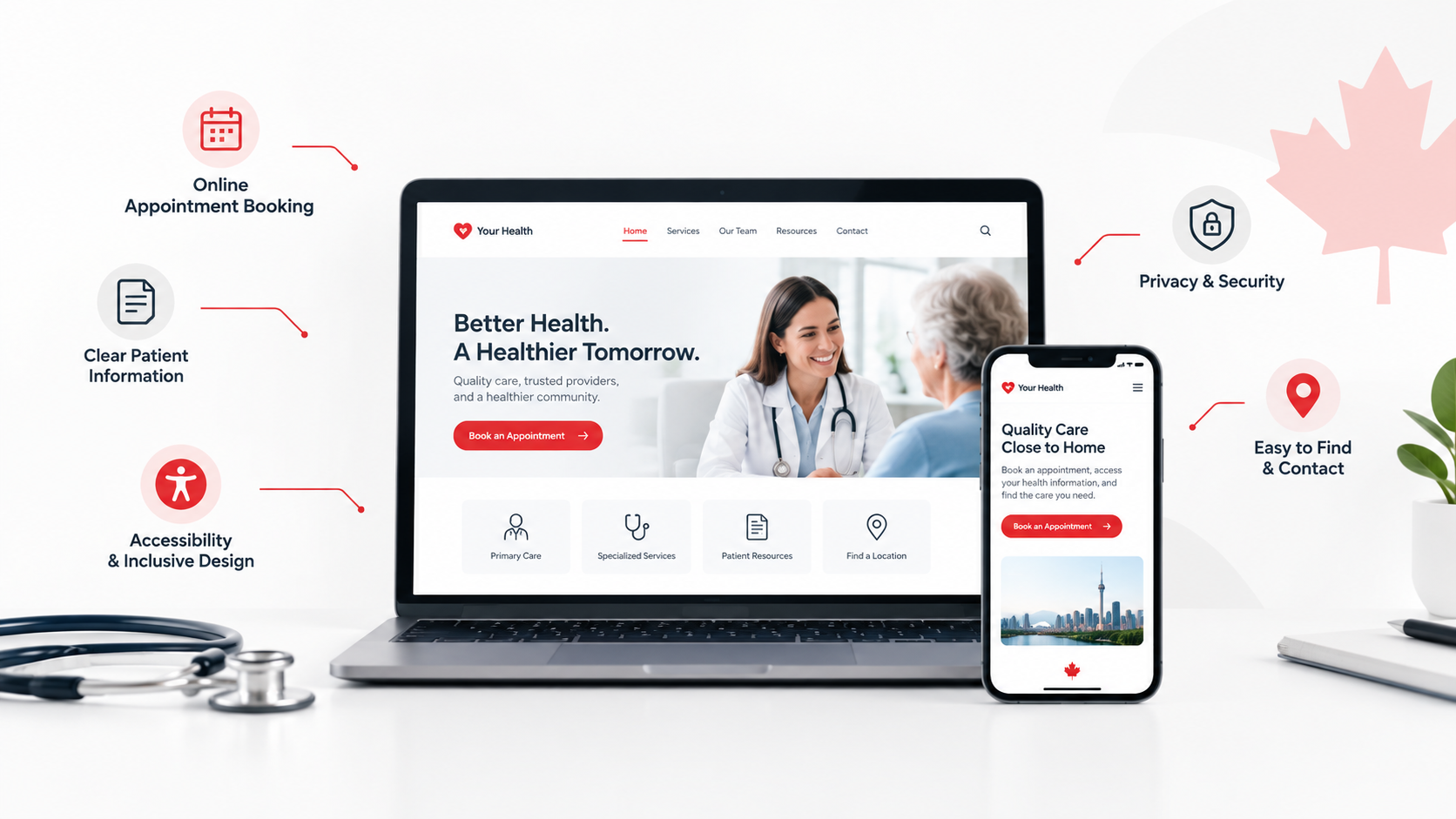
For many Canadians, a healthcare website is the first place they visit when looking for a clinic, healthcare provider, treatment, or appointment. This makes the website more than an online brochure. It is a key part of how patients find information, and connect with healthcare services.
An effective healthcare website should be easy to use, accessible, mobile-friendly, secure and built around real patient needs. It should also provide accurate information that search engines, and AI tools can understand.
Key Features of an Healthcare Website
Here are the main features that make a healthcare website effective in Canada.
Make Important Information Easy to Find
Patients usually visit a healthcare website with a specific goal. They may want to find a service, check clinic hours, learn about a doctor, or book an appointment.
The main navigation should make these tasks simple.
Important pages may include:
- Services and treatments
- Provider profiles
- Appointment booking
- Clinic locations
- Hours of operation
- Contact information
- Patient resources
- Frequently asked questions
- Insurance and payment information
Use clear page titles, short sections, descriptive buttons, and simple menus. Patients should not have to search through several pages to find basic information.
Design for Mobile Users
A large number of people use smartphones to search for healthcare services. A healthcare website should therefore work properly on phones, tablets, and desktops.
Mobile users should be able to read text without zooming, tap buttons easily, complete forms, and find contact information without unnecessary scrolling.
Appointment booking deserves special attention. If a form is difficult to use on a phone, patients may leave the site before completing it.
Mobile performance also supports search visibility. A responsive website with fast-loading pages can provide a better experience for users, and search engines.
Make Accessibility Part of the Design
Healthcare information should be available to people with different abilities. Websites need to consider visitors who use screen readers, keyboard navigation, captions, larger text, or other assistive technologies.
Useful accessibility practices include:
- Good colour contrast
- Descriptive alt text for images
- Keyboard-friendly navigation
- Logical heading structures
- Accessible forms
- Captions for videos
- Clear link descriptions
- Resizable text
Canadian healthcare organizations should also consider accessibility requirements that apply in their province or territory.
Canadian healthcare website accessibility is important because patients should be able to access essential information without unnecessary barriers.
Write Content in Plain Language
Healthcare topics can be difficult to understand when websites rely heavily on medical terminology. Content should remain accurate while using language that ordinary patients can understand.
Instead of filling a treatment page with technical details, answer the questions patients are likely to ask:
- What is the treatment?
- Who may need it?
- What happens during the appointment?
- How should I prepare?
- How long does it take?
- When should I contact the clinic?
This approach helps patients understand services before they make contact.
It also supports AEO. Well-structured answers can make it easier for search engines, and AI systems to identify useful information, and match it with relevant questions.
Include Strong Local Information
Location matters when people search for healthcare services. Someone looking for a clinic in Toronto has different needs from someone searching in Calgary, Vancouver or Halifax.
Healthcare websites should clearly state:
- Clinic addresses
- Cities and neighborhoods served
- Opening hours
- Phone numbers
- Available services by location
- Directions or parking information where useful
Organizations with multiple locations can create dedicated location pages with information that is specific to each clinic.
Consistent business details across the website and major online listings can also support local search visibility.
Keep Healthcare Information Current
Outdated information can create problems for patients, and healthcare organizations. Incorrect opening hours, old provider profiles, or unavailable services can lead to confusion.
Set a regular schedule for reviewing website information.
Check details such as:
- Provider availability
- Clinic hours
- Services
- Appointment instructions
- Contact details
- Fees
- Locations
- Patient forms
Provider profiles should include factual information such as qualifications, areas of practice, and relevant professional memberships.
For health-related educational content, showing the author or reviewer and the date of review can also help users understand how current the information is.
Protect Patient Information
Healthcare websites may collect personal information through contact forms, appointment requests, patient portals and other tools.
Visitors should be able to understand how their information is collected, and used. A clear privacy policy should be easy to find.
Websites that collect personal information should use HTTPS, and appropriate security measures. Forms should also request only information that is necessary for the stated purpose.
Clear privacy information can help users understand what happens after they submit their details.
Use Design to Guide Patients
Healthcare design should support practical tasks rather than simply focus on appearance.
A premium website design for healthcare industry should use readable typography, clear navigation, suitable imagery, accessible layouts and visible calls to action.
Buttons should tell users what will happen next. Examples include:
- Book an Appointment
- Contact the Clinic
- Find a Location
- Call the Office
- View Services
Avoid excessive animation, cluttered layouts, or design elements to make important information harder to access.
Build a Strong Technical SEO Foundation
Good content needs a technically sound website behind it. Search engines need to crawl, understand, and index the site's pages.
Healthcare websites should pay attention to:
- Page titles
- Meta descriptions
- Heading structure
- Internal links
- Descriptive URLs
- Schema markup where relevant
- XML sitemaps
- Page speed
- Mobile usability
- Crawlability
Healthcare content also requires careful attention to accuracy, and trustworthy sources because users may rely on this information when making health-related decisions.
Structure the Website Around Patient Needs
A healthcare website should support the complete path from search to action.
A typical journey might look like:
Search → Visit website → Find service → Review provider → Check location → Book or contact
Each step should provide the information needed to move forward.
This is where Healthcare digital experience for Canadian patients becomes important. Content, design, accessibility, local information and technical performance should work together rather than being treated as separate website features.
What Canadian Healthcare Websites Should Aim For
An effective Canadian healthcare website solution should make it easy for patients to find reliable information and take the next step. That means clear content, mobile usability, accessibility, accurate local details, privacy, strong technical SEO, and patient-focused design.
For healthcare organizations in Canada, the goal is clear to provide useful information in a format that patients can understand, and use. A website built around these principles can serve patients better while giving search engines and AI systems clearer information about the organization and its services.