


Choosing a member management system can affect how an association handles member records, renewals, events, communications, payments, and daily administrative work.
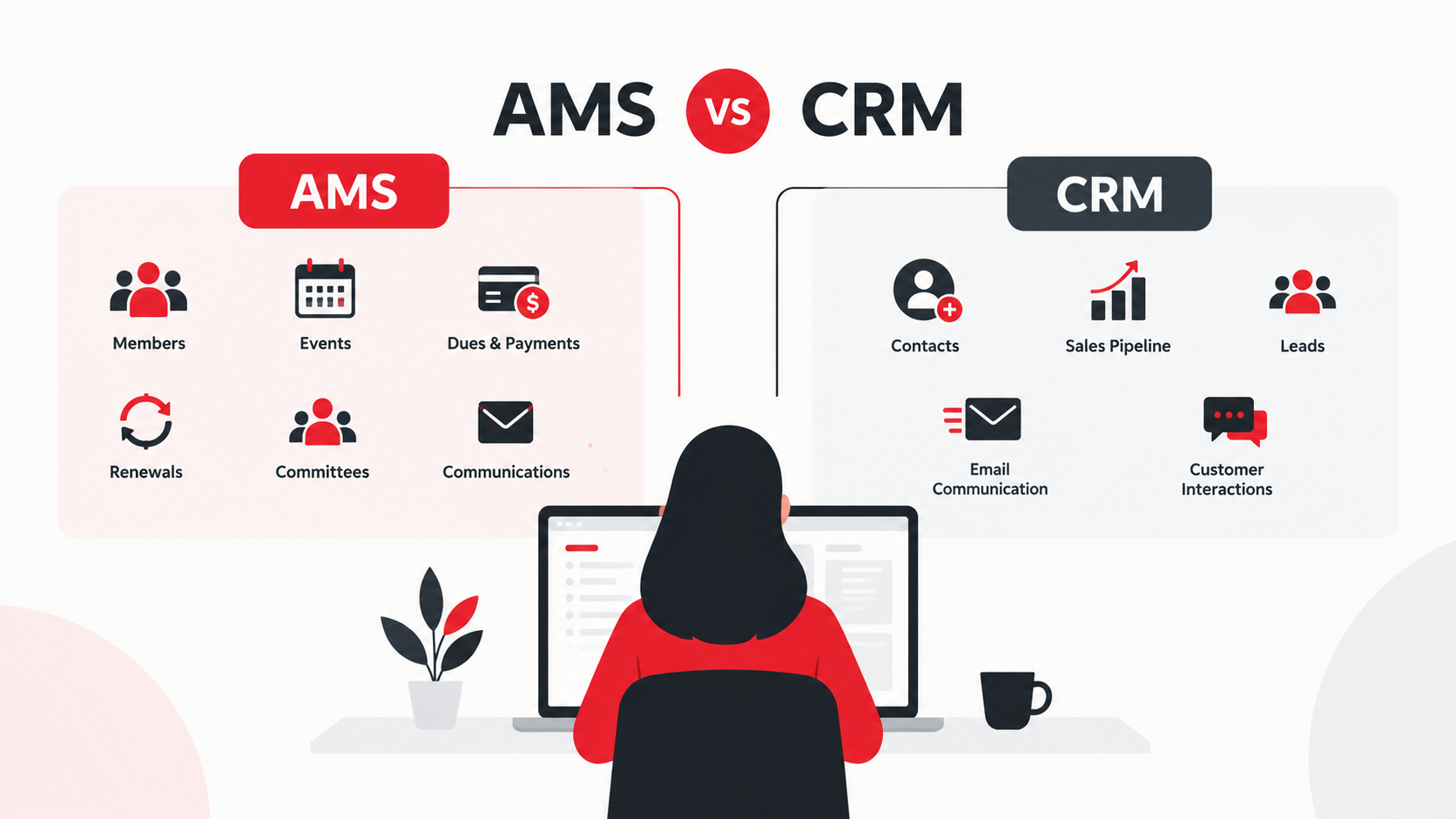
When comparing AMS vs CRM for associations, it is important to understand that these systems are designed for different primary purposes. An Association Management System (AMS) is generally built around membership operations, while a Customer Relationship Management (CRM) system focuses on broader relationships and interactions.
Some associations may need an AMS, some may need a CRM, and others may benefit from connecting both systems.
What Is an AMS and CRM?
An Association Management System (AMS) is designed for membership organizations. It typically supports activities such as:
- Member applications
- Membership categories
- Renewals and expirations
- Dues and payments
- Event registration
- Member directories
- Committees and groups
- Certification and education records
- Member communications
- Reporting
A Customer Relationship Management (CRM) system is designed to manage relationships with a wider range of contacts. These can include members, prospective members, sponsors, donors, partners, volunteers, event attendees, and other professional contacts.
CRMs commonly provide tools for communication tracking, marketing automation, engagement management, custom workflows, reporting, and integrations with other business systems.
AMS vs CRM Differences and Benefits for Association Management Software
The main difference between an AMS and CRM is the type of work each system is designed to support.
| Area | AMS | CRM |
|---|---|---|
| Member management | Strong focus | Usually requires configuration |
| Membership renewals | Common built-in function | May require customization |
| Dues management | Typically supported | Often handled through integrations |
| Event registration | Common feature | May require an add-on or integration |
| Member directories | Often available | Usually requires configuration |
| Marketing automation | Varies by platform | Often a strong capability |
| Relationship tracking | Membership-focused | Broad relationship tracking |
| Custom workflows | Varies by platform | Often highly configurable |
| Integrations | Varies by platform | Usually extensive |
| Association-specific processes | Usually stronger | May require customization |
An AMS can provide association-specific tools for managing membership administration. A CRM can provide greater flexibility for managing different types of relationships, communications, campaigns, and workflows.
The right option depends on which activities take up most of the association’s daily work and which systems need to connect with one another.
When an AMS Can Support Staff Efficiency
An AMS can be useful for associations where membership administration is a major part of daily operations.
Staff may use an AMS to manage applications, membership categories, renewals, dues, benefits, events, directories, committees, and education records from a central system.
Using a membership-focused platform can reduce the need to manage these processes across multiple separate tools. This can be particularly useful for teams looking for the best AMS for staff efficiency, although the right choice will depend on the association’s workflows, membership structure, integrations, and reporting requirements.
Staff efficiency can also depend on how well the AMS works with the association’s website, CRM, accounting platform, email tools, and other systems.
When a CRM May Be Useful for an Association
A CRM can be useful when an association manages relationships beyond its current membership base.
These relationships may include:
- Prospective members
- Sponsors
- Donors
- Partners
- Volunteers
- Event attendees
- Professional contacts
A CRM can help staff track communications, manage campaigns, segment contacts, monitor engagement, and create custom workflows.
For associations with extensive relationship-management or marketing requirements, these capabilities may complement the membership functions provided by an AMS.
Smarter Workflows With AMS CRM Integration for Associations
An association does not always need to choose between an AMS and CRM. The two systems can be connected so each handles the functions it is best suited to manage.
An AMS can manage membership records, renewals, dues, and member status, while a CRM can handle broader relationship management, marketing, and engagement.
The association website can connect these systems and provide member-facing services such as:
- Member profiles
- Membership renewals
- Event registration
- Payments
- Member directories
- Gated content
- Member dashboards
- Single sign-on
Inorbital’s association solutions include integration with AMS and CRM platforms such as iMIS, Salesforce, Microsoft Dynamics, and Blackbaud. Its association website solutions can support member portals, member profiles, directories, payments, event registration, gated content, and single sign-on.
What to Consider Before Choosing an AMS or CRM
Before selecting a platform, associations should assess their current processes and technology requirements.
Consider questions such as:
- How are member applications and renewals managed?
- How are dues and payments handled?
- What should members be able to do through the website?
- Where is member data currently stored?
- Does staff have to enter the same information more than once?
- How are events and registrations managed?
- Is marketing automation required?
- Which systems need to exchange data?
- How much customization is needed?
- What technology requirements are expected over the next few years?
These questions can help determine whether an association needs an AMS, CRM, or connected system architecture.
How Inorbital Supports Association Member Management
An association website should work with the systems an organization already uses. Inorbital designs and develops association websites and member portals using Xperience by Kentico, with integrations planned around existing AMS, CRM, CMS, payment, and other business systems.
Its work includes the Ontario Psychological Association project, where an existing iMIS AMS was replaced with a custom solution supporting member dashboards, payments, registration, directories, renewals, and reporting.
This approach allows associations to build digital services around their actual workflows and technology requirements rather than relying solely on standard platform functionality.
Finding the Right Member Management Approach
An AMS is generally centered on membership administration, while a CRM is designed for broader relationship management. Associations that need both can connect the systems through their website and other business tools.
The right approach depends on membership processes, staff workflows, data requirements, integrations, and member-facing services.
If your association needs to connect its website, member portal, AMS, CRM, or other systems, contact the Inorbital team to discuss your requirements.